By Ivan Volovenko, Founder of Ivenko Studio
In a New York apartment, a radiator often occupies useful wall space. It’s often directly below a window, on the only usable wall in a bedroom, or in the middle of an area that could otherwise support shelving, a bench, or storage.
That’s why the best radiator cover ideas start with more than appearance. A radiator is heating equipment, and whatever surrounds it has to work with that equipment rather than simply hide it.
This is particularly important in New York. Steam heating remains widespread in the city’s multifamily housing stock, and exposed radiators can operate at very high temperatures. NYC Housing Preservation and Development notes that steam radiators can reach temperatures up to 220°F. The enclosure also has to let heat reach the room and keep the radiator, valves, vents, and piping accessible for inspection and maintenance.
A well-planned cover can make the radiator part of the architecture and sometimes add a shelf, storage, or seating. I’d never decide on any of those features before identifying exactly what type of equipment is being enclosed.
Why Radiators Are a Design Challenge in NYC Apartments
There’s no single “NYC radiator.”
A prewar apartment may have a one-pipe or two-pipe steam radiator with visible valves and piping. Another building may use a hydronic radiator, convector, PTAC, or another heating and cooling unit below the window. These systems may occupy a similar part of the room, but they shouldn’t automatically receive the same enclosure.
Site conditions vary just as much. We frequently have to account for window sills, deep casings, baseboards, pipes entering through the floor, valves extending beyond the radiator body, uneven walls, and limited space between the radiator and nearby furniture.
The first step in deciding how to hide a radiator is therefore to document the radiator and its surroundings before designing the enclosure.
I want to know its full width, height, and depth, including pipes and controls. I also want to know how the equipment is serviced, where air needs to enter and leave the enclosure, how the window operates above it, and what surrounds it on both sides. That information determines whether the design should be a simple cover, a longer architectural enclosure, or a radiator integrated into a larger built-in.
Simple Radiator Cover Ideas for Small Rooms
A radiator cover doesn’t need to become a major piece of cabinetry.
In a small bedroom or entry, one of the most effective solutions can be a straightforward fitted enclosure with a vented front or top and a usable surface above. If the cover lines up with the window sill or nearby trim, it can visually simplify the wall.
Another option is to extend the top beyond the radiator itself, creating a longer horizontal line. This can work well below a wide window or where two sections of wall otherwise feel disconnected.
Depth is important in a tight apartment. Building an unnecessarily deep enclosure around a shallow radiator can make circulation worse, so I generally prefer to keep the enclosure as compact as the equipment and airflow requirements allow.
The same restraint applies to decorative detailing. A prewar room doesn’t automatically need an ornate grille. A simple painted enclosure can work with substantial traditional casing if the proportions are right. Natural wood may make more sense when the cover is intended to look like furniture or connect visually with other millwork.
The goal isn’t to make the radiator cover the most noticeable object in the room. Often, the better result is the one that makes you stop noticing where the radiator is.
Radiator Covers With Shelves
A shelf is one of the easiest ways to give a radiator enclosure another function, but there are several ways to approach it.
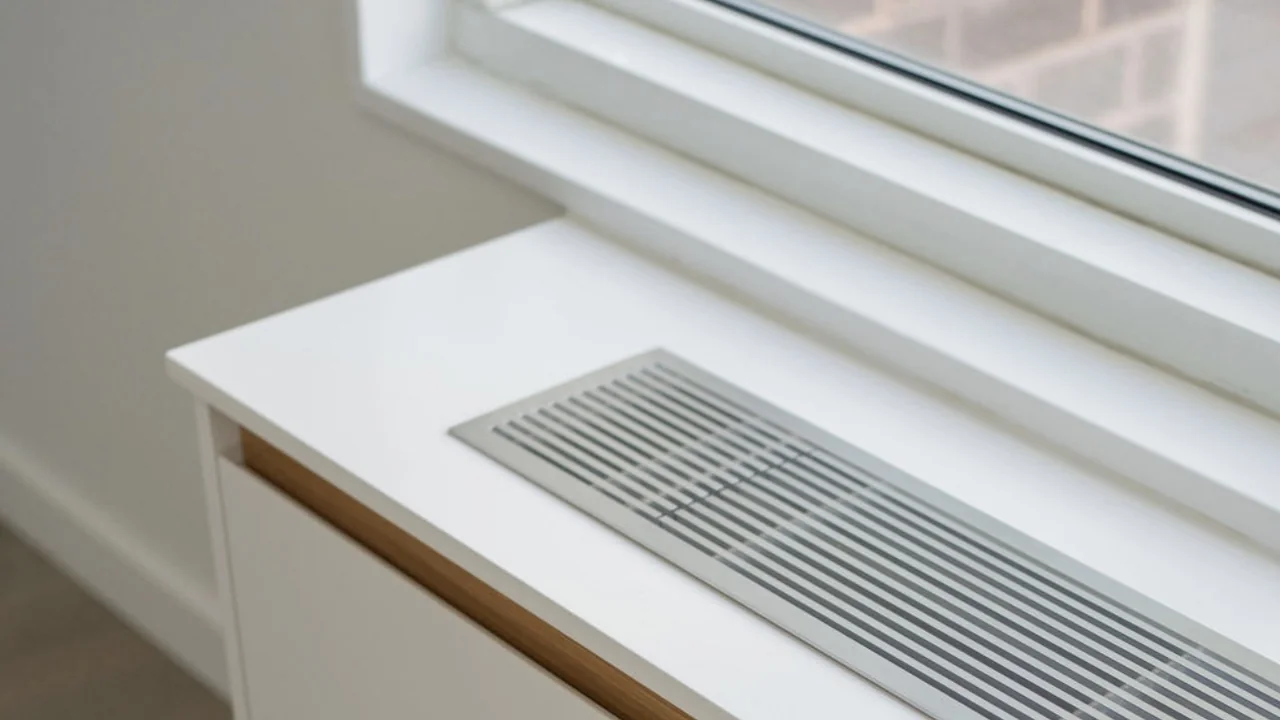
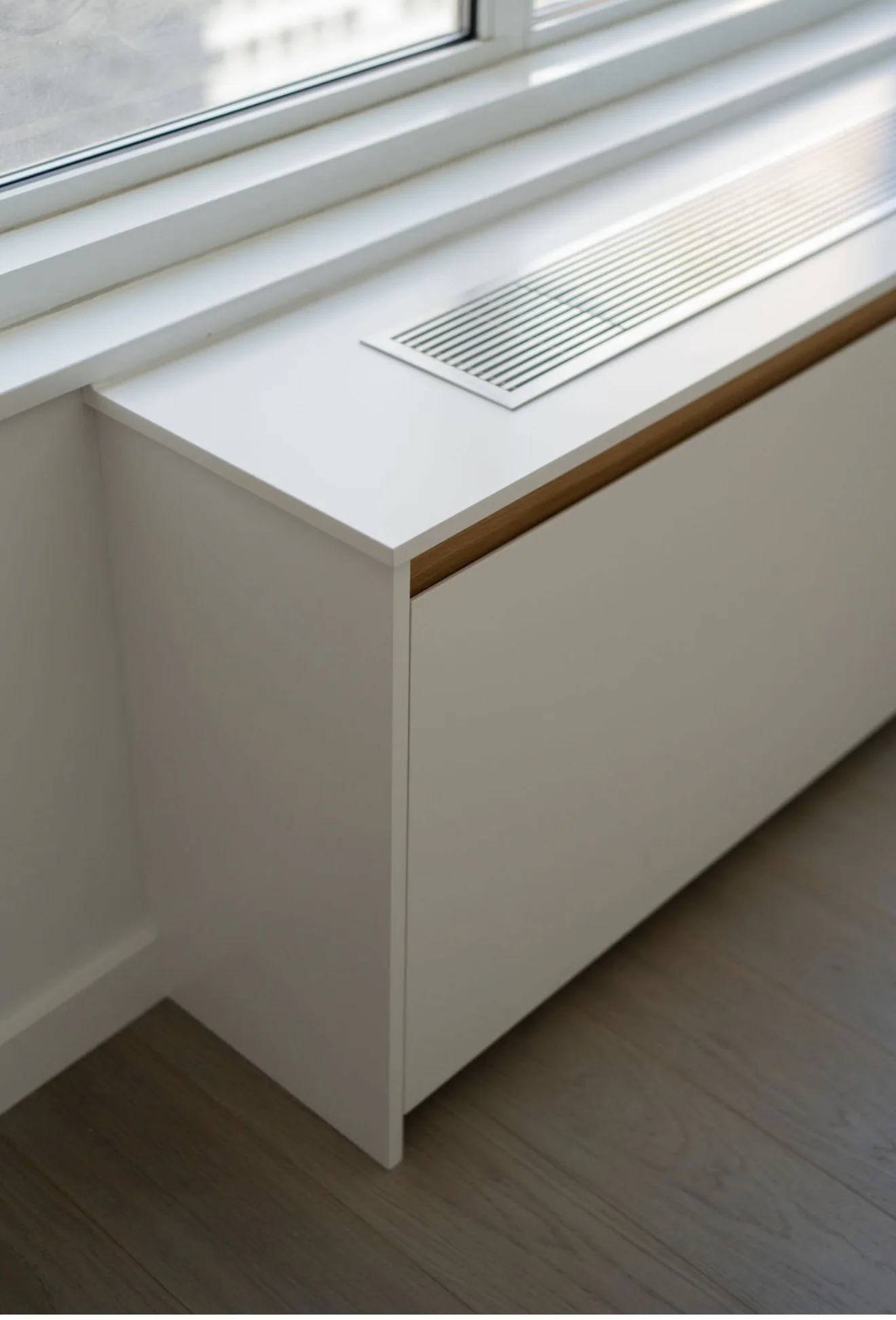
The top of the cover itself can become a narrow display surface. In one of our Manhattan radiator-cover projects, the upper panel works as a shelf or extension of the window area while a recessed grille provides an outlet for warm air. The front panel is removable so the equipment remains accessible.
On a larger wall, shelving can sit beside the radiator rather than directly above it. That allows the enclosure to become part of a bookcase or living-room built-in without turning the area immediately around the heat source into storage.
A rendering may show shelves fitted tightly around a radiator because the arrangement looks efficient. The built version still has to account for heat, airflow, what will be stored there, and access to the equipment.
Books, electronics, artwork, and other heat-sensitive objects shouldn’t be placed wherever there happens to be an open shelf without considering the temperature in that area. I prefer to think of the radiator as one zone within the millwork. Shelving can line up with the radiator visually without putting stored objects in the heated area around it.
Radiator Covers With Hidden Storage
A radiator cover with storage can work very well in an apartment where the radiator already occupies a valuable section of wall. The important question is where that storage goes.
In many cases, the most useful solution is to place enclosed cabinets or drawers beside the radiator chamber rather than turning the space directly around the radiator into a closed cabinet. A long window wall, for example, might have the radiator at the center with storage cabinets on one or both sides. The top can continue across the composition, and the fronts can share the same proportions and finish even though the internal construction is different.
The result looks like one continuous built-in while keeping the radiator chamber separate from the storage.
Hidden storage is particularly useful for items that don’t need full cabinet depth, including games, toys, linens, household supplies, files, and other smaller objects. In a narrow NYC room, reducing cabinet depth where possible can preserve more usable floor area.
You also need to plan how the radiator will be reached for maintenance. A cabinet door that gives access to storage isn’t automatically sufficient access to the radiator. Valves, vents, pipe connections, and the radiator itself may need to be reached independently.
Access has become even more important under New York’s steam-radiator inspection requirements. Under Local Law 151 of 2025, covered multiple dwellings with steam heating are subject to radiator inspection requirements in specified units and common areas. HPD’s inspection procedure includes examination of the radiator, supply valve, exposed piping, joints and connections, and surrounding walls and floors.
A removable front, hinged panel, or another deliberate access detail is much better than discovering later that finished millwork has made the equipment difficult to inspect.
Radiator Cover Window Seat Ideas
A radiator below a large window naturally suggests a bench, and in the right conditions a radiator cover window seat can be an excellent use of that wall.
I would design it as a bench that integrates the radiator rather than treat a radiator cover as a seat. The bench needs its own structural support. The radiator, valves, and piping shouldn’t be treated as structural components or receive loads from the bench.
Seat height and depth also have to work with the existing sill, window operation, heating equipment, and required ventilation. A longer window seat can sometimes combine several functions: a ventilated radiator section, adjacent closed storage, and a continuous top surface. The result looks like one piece of millwork even though each section is solving a different problem.
When the seat is directly under a window, there is another NYC-specific issue to consider: child window safety.
New York City requires approved window guards or limiting devices in buildings with three or more apartments when a child age 10 or younger lives in the apartment, subject to specific exceptions such as windows providing access to fire escapes. A built-in window seat shouldn’t interfere with required guards, limiting devices, or safe window operation. NYC guidance also warns against positioning climbable furniture near unguarded windows where young children are present.
These requirements may not apply in an adult-only apartment. If they do apply, account for them during design rather than after installation.
How to Hide a Radiator Without Blocking Heat
The biggest technical mistake in many hide radiator ideas is treating ventilation as decoration. Adding a small decorative grille to an otherwise closed box doesn’t automatically mean the radiator can operate as intended.
Radiators transfer heat partly by warming the air around them. U.S. Boiler describes the convection path in one of its cast-iron radiator systems clearly: cooler air enters from below, warms as it passes through the radiator, and exits above. NYCHA similarly advises residents to move furniture away from radiators and baseboards so air can move freely.
For an enclosure, the important thing is the complete air path. Where does cooler room air enter? Where does heated air leave? What happens between those two points?
A top grille may be appropriate for one installation. Another may require a ventilated front, an open bottom, different internal clearances, or a combination of openings.
I don’t recommend applying one universal clearance such as “always leave two inches” to every radiator. Manufacturers publish different dimensions for different enclosures, so I wouldn’t copy one generic clearance rule across every installation. The right clearance depends on the radiator, enclosure design, materials, and heating system.
If enclosing the unit noticeably changes how the room heats, the problem is no longer cosmetic. The enclosure design needs to be reconsidered.
Design Details: Grilles, Wood Finishes, Access Panels, and Safety
Once the mechanical requirements are resolved, there is much more freedom in the visual design.
Grilles
The grille pattern affects appearance, while its open area and location affect function. Perforated metal, linear slots, horizontal or vertical slats, and recessed top grilles can all work in the right application. I would choose the pattern only after deciding how air needs to move through the enclosure.
Wood and Painted Finishes
A painted cover can disappear into a wall or existing trim. Natural wood can make the piece look more like furniture. Ivenko Studio has used both approaches in Manhattan projects, including a natural-wood enclosure with softened edges and a white architectural cover with a recessed ventilation grille and wood accent.
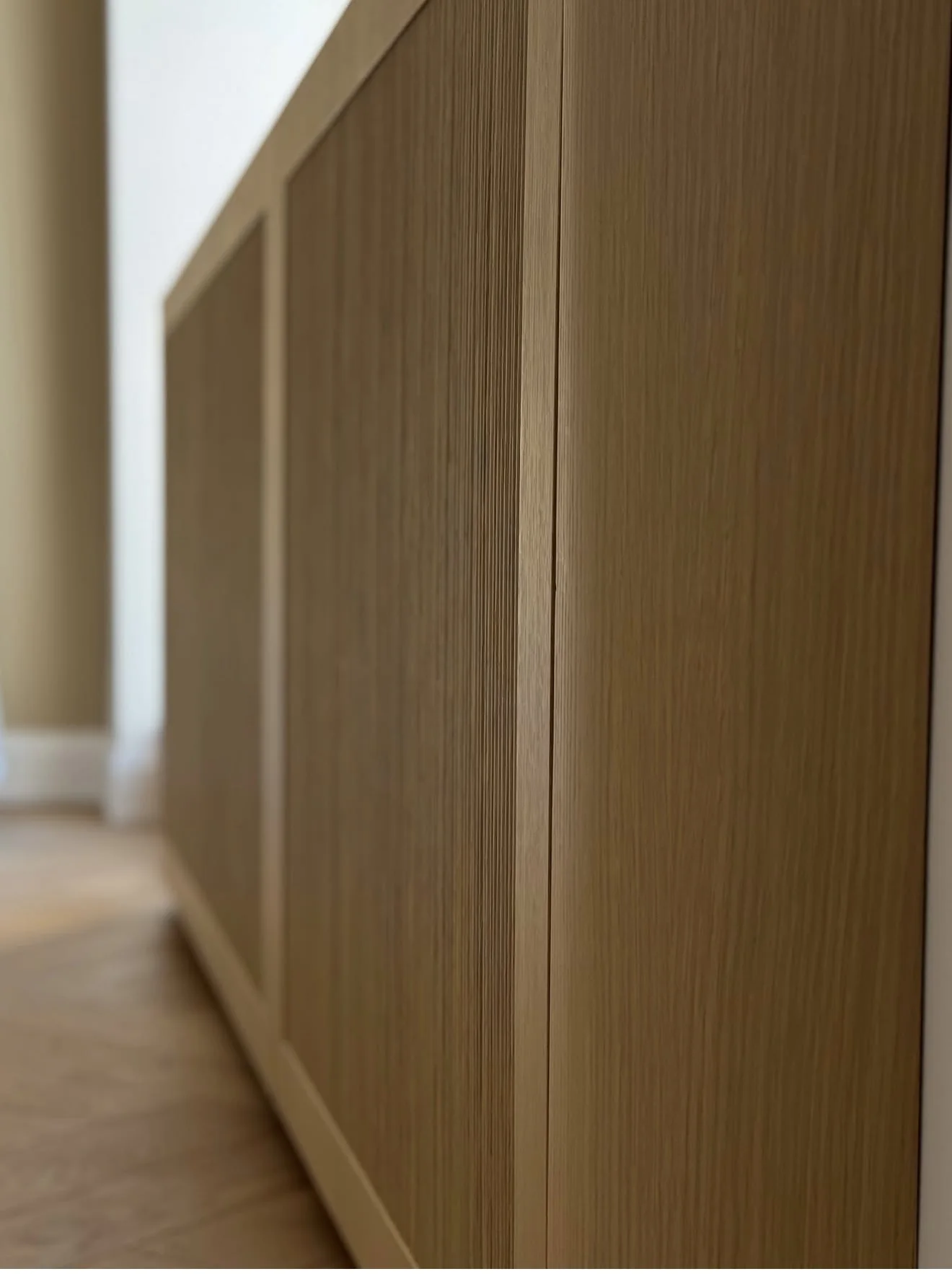
Choose materials around steam heat carefully. HPD’s current steam-radiator inspection guidance specifically instructs inspectors to note combustible materials near radiators or piping, along with evidence of overheating or other system problems. That is another reason not to choose the substrate, finish, spacing, or upholstery for a radiator bench from a photograph alone.
Access Panels
Access panels should be planned from the beginning. Magnetic removable fronts, hinged sections, or discreet doors can keep valves and service points reachable without leaving obvious hardware on the face of the millwork.
Pipes and Valves
Don’t measure only the radiator body. A valve in its operating position, exposed piping, vents, and fittings can define the actual required enclosure dimensions.
When evaluating radiator cover design ideas, resolve these details before fabrication. Once these details are resolved, the radiator can become much less noticeable. The enclosure may provide a shelf, integrate into a bench, form part of a storage wall, or simply keep the radiator from drawing attention away from the rest of the room.
FAQ
Do radiator covers block heat?
They can. An enclosure that restricts the air entering or leaving the radiator can reduce heat delivery to the room. The effect depends on the radiator and cover design, which is why ventilation should be planned around the specific equipment rather than treated as a decorative grille added afterward.
Can a radiator cover include storage?
Yes, when the radiator type, heat conditions, available space, and service requirements allow it. I generally prefer storage in adjacent or separately constructed sections so the radiator remains ventilated and accessible.
Can I turn a radiator cover into a window seat?
In suitable conditions, yes. The bench should be engineered to support seating loads independently of the radiator and its piping while preserving ventilation and access. Window operation and, where applicable, NYC window-guard requirements should also be considered.
Should a radiator cover have a grille on the top or front?
There isn’t a universal answer. The correct opening arrangement depends on the radiator type and the intended airflow path. Some installations use both lower or front intake and upper exhaust openings; others require a different configuration.
Does a radiator cover need to be removable?
At minimum, the design should provide practical access to components that may need operation, inspection, repair, or replacement. For steam radiators, that can include the supply valve, vent or trap, connections, piping, and radiator body. A removable or hinged panel is often the cleanest solution.
Can I cover a PTAC or HVAC unit the same way as a steam radiator?
No. A PTAC or other HVAC unit has its own supply and return airflow, controls, filters, and manufacturer service requirements. An enclosure should be designed around the specific equipment rather than adapted from a conventional radiator-cover detail.
A radiator doesn’t have to remain an isolated utility object, but hiding it should never come at the expense of the heating system.
The best solution starts by identifying the equipment and documenting the room. From there, you can decide what additional function would actually be useful on that wall. The cover may become a shelf, part of a storage wall, a window seat, or simply a quieter part of the architecture.
If you are planning a custom radiator cover or integrated millwork for a New York apartment, Ivenko Studio can review the equipment, room conditions, and intended use before developing the enclosure.